
Infusion Pump Repair & PM for Infusion Suites, ASCs & Physician Groups
PBES keeps IV and syringe pumps delivering accurate volumes and pressures — with service for occlusion alarms, cassette doors, batteries, and flow-rate verification.
- Volumetric and syringe pump expertise
- Flow-rate verification on PM visits
- Battery and door-mechanism service
- Documented reports via TESSA
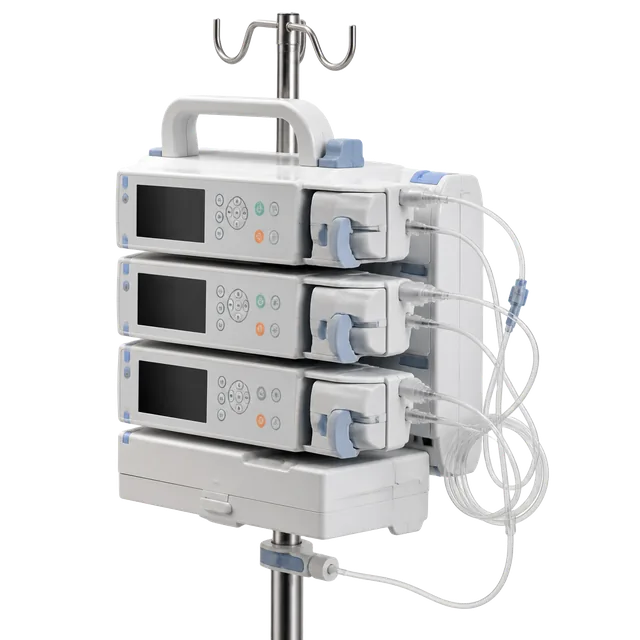
Every PM visit verifies flow accuracy, occlusion thresholds, battery capacity, and alarm behavior before the pump returns to clinical use.
- Service Type
- Infusion pump repair, PM, and flow verification
- Equipment Supported
- Volumetric infusion, syringe, and enteral feeding pumps
- Common Issues
- Occlusion, air-in-line, door latch, battery, flow drift
- Facilities Served
- Infusion suites, ASCs, oncology and physician groups
At a glance
A quick summary of this service.
The problem
When a pump alarms mid-infusion, patient care and clinician trust both take a hit.
Infusion pumps are on constantly — occlusion alarms, air-in-line, cassette-door faults, and low-battery shutdowns all pull nurses off the floor and put an infusion on hold.
The underlying cause is usually mechanical (door latch, pumping mechanism, sensors) or consumable (battery, tubing set) — but flow-rate drift is the one that has the biggest patient-safety implication and is only caught during a proper PM.
PBES services these pumps, verifies flow rate, and documents the outcome so the equipment record actually reflects the state of the fleet.
Common issues
What we commonly see on infusion pumps.
Most calls come down to a specific alarm pattern, a worn mechanical part, or a PM that never happened.
Occlusion alarms
Upstream or downstream occlusion alarms triggered on new or reused sets.
Air-in-line faults
False air-in-line alarms interrupting infusions.
Cassette / door issues
Door won't latch, sensor won't recognize a set, or door-open alarm during use.
Flow-rate accuracy
Flow-rate drift outside manufacturer tolerance identified on verification.
Battery failures
Won't hold a charge, shutdown when unplugged, or age-related capacity loss.
Keypad / display
Unresponsive keys, screen flicker, or intermittent boot behavior.
Pumping-mechanism wear
Peristaltic finger or platen wear affecting pump performance.
Electrical safety findings
Ground continuity or leakage current out of range on inspection.
PM overdue
Pumps past their recommended service interval without flow verification.
Our approach
How PBES handles every service visit.
A disciplined sequence, delivered the same way on every device — so your team gets consistent service and consistent documentation through TESSA.
- Step 01
Document the reported issue
Capture symptoms, error codes, history, and how the problem is affecting the workflow.
- Step 02
Identify equipment and asset details
Confirm make, model, serial, and control number so the record ties back to the right device.
- Step 03
Inspect and test the device
Visual inspection plus operational testing appropriate for the equipment and reported issue.
- Step 04
Troubleshoot the likely cause
Based on manufacturer guidance and service findings, isolate the probable cause or next step.
- Step 05
Perform service, PM, or recommendation
Adjustments, cleaning, wear-part replacement, or clear repair recommendations when parts and scope allow.
- Step 06
Verify operation and document in TESSA
Post-service verification and a clean written report you can hand to an administrator or surveyor.
TESSA · The PBES advantage
Every pump on the floor, with flow verification captured on the record.
TESSA gives infusion managers and biomeds visibility into every pump — PM status, flow-verification results, battery history, and recurring alarm patterns across the fleet.
TESSA — Technical Equipment Support and Service Assistant — is how PBES organizes equipment records, service history, PM status, and repair follow-up for the facilities we serve.
- Pump inventory by make, model, serial, and location
- Flow-verification results captured on each asset
- PM status and next-due visibility
- Battery replacement history documented
- Electrical safety inspection records on the same record
- Multi-site rollups for administrators
Documentation
Clear documentation after every service visit.
TESSA helps PBES produce clean, consistent service documentation — the record your administrators, biomed program, and surveyors expect to see.
- Equipment identification (make, model, serial)
- Reported alarm patterns and clinical symptoms
- Mechanism, door, and sensor inspection
- Flow-rate verification results
- Occlusion threshold check
- Battery test results
- Electrical safety findings when applicable
- Recommendations and follow-up
- Facility
- Example Facility
- Equipment
- Make / Model
- Serial
- SN-XXXXXXX
- Technician
- PBES field service
- Visit date
- MM / DD / YYYY
- Report ID
- TESSA-INF-000123
Example: reported issue evaluated, functional testing performed, findings and recommendations documented for facility records.
Example layout · anonymized for demonstration
Related PBES services
Explore related biomedical services.
Facilities served
Healthcare organizations PBES supports.
Service area
Nationwide service. Florida-headquartered.
PBES supports single-location practices and multi-site healthcare groups in 27 states, coast to coast. Same team, same standards, wherever your facilities are.
See full coverageFAQ
Frequently asked questions.
How often should infusion pumps have PM?
Most infusion pumps benefit from at least an annual PM with flow-rate verification, often paired with an electrical safety inspection.
Do you verify flow-rate accuracy?
Yes. Flow-rate verification is a standard part of PBES infusion-pump PM visits and results are captured on the equipment record.
Can you service both volumetric and syringe pumps?
PBES supports many common volumetric, syringe, and enteral feeding pumps. Specific capabilities depend on make, model, and parts availability.
Do you replace pump batteries?
Yes. When compatible batteries are available, PBES replaces them and documents the change on the equipment record.
Can PBES help across multiple sites?
Yes. TESSA is built for multi-site organizations so PM status and flow-verification history are visible across every location.
Do you handle recall or software-update tracking?
PBES captures known issues and outstanding manufacturer bulletins on the equipment record so administrators have visibility.
What documentation do we receive after a PM?
A written PM report including flow-verification results, alarm-check outcomes, battery status, and any recommendations — filed on the asset in TESSA.
Talk to PBES
Keep every pump accurate and inspection-ready.
Talk to PBES about infusion-pump repair, PM, flow verification, and inspection documentation across your facility.