
Fire Door Inspections for medical facilities
PBES performs annual fire and smoke door assembly inspections with trained and certified fire door inspection technicians, following the NFPA 80 inspection checklist that NFPA 99 and NFPA 101 point to for healthcare occupancies.
- Trained and certified fire door inspection technicians
- NFPA 80 checklist applied door by door
- Per-door pass / deficiency record with photos
- Scheduled alongside your other PBES service visits
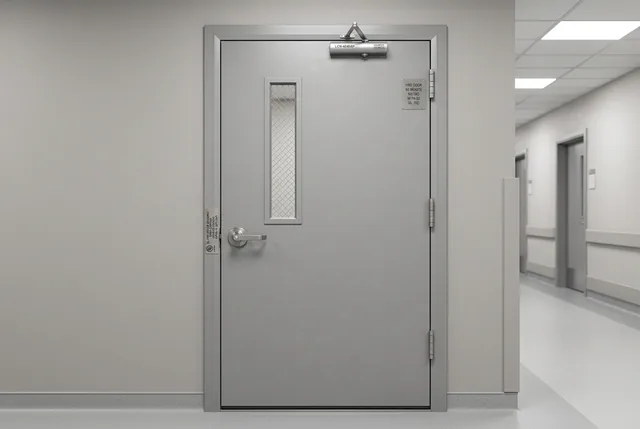
Each fire and smoke door assembly is identified, inspected against the full checklist, and recorded individually — label, clearances, closing and latching, hardware, and field modifications.
- Service Type
- Annual fire and smoke door assembly inspection
- Reference Standard
- NFPA 80 inspection criteria, as referenced through NFPA 99 and NFPA 101
- Performed By
- Trained and certified fire door inspection technicians
- Facilities Supported
- ASCs, clinics, community health centers, and multi-site outpatient groups
At a glance
A quick summary of this service.
The problem
Fire doors are a survey item, and they fail quietly.
A fire door assembly only works if every part of it works: the label is still legible, the gaps are within tolerance, the closer swings the door fully shut, and the latch actually catches. Any one of those failing turns a rated assembly into an ordinary door.
In practice, doors drift out of compliance from ordinary use — a kick-down holder installed for convenience, a sign screwed into the door face, a latch adjusted because staff found it stiff, hinges worn after years of traffic.
Surveyors expect an annual inspection record for fire and smoke door assemblies, and they expect deficiencies to be tracked. PBES performs that inspection with certified technicians and produces the per-door record behind it.
Common issues
What the inspection covers
Each door assembly is inspected against the standard checklist points. Findings are recorded per door, with photos where they help explain the condition.
Labels present and legible
Door, frame, and hardware labels intact and not painted over or removed.
No holes, breaks, or field modifications
Unapproved cutouts, screw holes, signage, and kick plates outside allowance.
Clearances and gaps
Perimeter gaps and undercut measured against the allowable range.
Self-closing operation
The door closes fully from the open position without assistance.
Positive latching
The latch engages and holds the door in the closed position.
Hardware condition and attachment
Hinges, closers, coordinators, and latching hardware secure and functional.
Frame, door, and glazing condition
Damage, warping, missing parts, and damaged or unrated glazing or vision panels.
Seals and gasketing
Smoke seals and intumescent seals present and intact where required by the assembly.
Unobstructed operation
Wedges, hold-open devices, storage, and blocked swing paths.
Hold-open device release
Magnetic hold-opens release and the door closes when the device is deactivated.
Our approach
How PBES handles every service visit.
A disciplined sequence, delivered the same way on every device — so your team gets consistent service and consistent documentation through TESSA.
- Step 01
Document the reported issue
Capture symptoms, error codes, history, and how the problem is affecting the workflow.
- Step 02
Identify equipment and asset details
Confirm make, model, serial, and control number so the record ties back to the right device.
- Step 03
Inspect and test the device
Visual inspection plus operational testing appropriate for the equipment and reported issue.
- Step 04
Troubleshoot the likely cause
Based on manufacturer guidance and service findings, isolate the probable cause or next step.
- Step 05
Perform service, PM, or recommendation
Adjustments, cleaning, wear-part replacement, or clear repair recommendations when parts and scope allow.
- Step 06
Verify operation and document in TESSA
Post-service verification and a clean written report you can hand to an administrator or surveyor.
TESSA · The PBES advantage
How PBES documents fire door inspections
Every door assembly is entered in TESSA with its own identifier and location. The inspection record shows what was checked, what passed, and what needs correction — so the deficiency list is a work list, not a paragraph.
TESSA — Technical Equipment Support and Service Assistant — is how PBES organizes equipment records, service history, PM status, and repair follow-up for the facilities we serve.
- Door identifier, building, floor, and location
- Checklist result recorded per criterion
- Photos attached to deficiencies where useful
- Deficiency list written in language a door contractor can act on
- Open findings tracked until the facility confirms correction
- Annual cycle scheduling with multi-site visibility
Documentation
Clear documentation after every service visit.
TESSA helps PBES produce clean, consistent service documentation — the record your administrators, biomed program, and surveyors expect to see.
- Door identifier, building, floor, and location
- Assembly type and fire-rating label information
- Result for each checklist criterion
- Measured clearances where applicable
- Photos of deficiencies where useful
- Overall pass or deficiency outcome per door
- Deficiency description and recommended correction
- Inspector name, credential, and date of inspection
- Facility
- Example Facility
- Equipment
- Make / Model
- Serial
- SN-XXXXXXX
- Technician
- PBES field service
- Visit date
- MM / DD / YYYY
- Report ID
- TESSA-FIR-000123
Example: reported issue evaluated, functional testing performed, findings and recommendations documented for facility records.
Example layout · anonymized for demonstration
Related PBES services
Explore related biomedical services.
Per-outlet receptacle testing and documentation for patient-care areas.
Annual ESI documentation for patient-care devices.
Manufacturer-aligned PM to reduce downtime.
Inventory, service history, PM and repair visibility.
Facilities served
Healthcare organizations PBES supports.
Service area
Nationwide service. Florida-headquartered.
PBES supports single-location practices and multi-site healthcare groups in 27 states, coast to coast. Same team, same standards, wherever your facilities are.
See full coverageFAQ
Frequently asked questions.
Are your fire door inspectors certified?
Yes. PBES fire door inspections are performed by trained and certified fire door inspection technicians. Fire door inspector certification is issued under NFPA 80 based programs, and our technicians inspect to the NFPA 80 criteria that NFPA 99 and NFPA 101 reference for healthcare occupancies.
Is NFPA 99 or NFPA 80 the standard for fire doors?
NFPA 80 is the standard that contains the fire door assembly inspection criteria. NFPA 99 and NFPA 101 govern healthcare facilities and point to NFPA 80 for door assemblies. In practice, a healthcare fire door inspection is an NFPA 80 inspection performed in an NFPA 99 / NFPA 101 environment.
How often do fire doors need to be inspected?
Fire door assemblies are generally inspected annually, and again after any repair or replacement work on the assembly. The specific frequency your facility must follow comes from the codes adopted by your authority having jurisdiction and your accreditation program.
Do you repair the doors you find deficiencies on?
PBES performs the inspection and produces the documentation. Corrective work on door assemblies is coordinated separately with a qualified door contractor. We can re-inspect and document the corrected assembly once the work is complete.
What does the deficiency list look like?
Each deficiency is tied to a specific door with its location, the checklist point that failed, a plain description of the condition, and a photo where it helps. It is written so a contractor can scope the work without a second walkthrough.
Can this be scheduled with our equipment service visits?
Yes. Many facilities pair fire door inspections with preventive maintenance, electrical-safety inspections, and outlet inspections so the annual compliance work happens on one coordinated visit.
Does a PBES inspection make our facility compliant?
PBES documents what was inspected, how, and what the outcome was. Whether your overall program satisfies a given surveyor depends on your facility's program, the codes your authority having jurisdiction has adopted, and how deficiencies are resolved. PBES does not certify facility compliance.
Talk to PBES
Get your annual fire door inspection on the calendar.
Trained and certified fire door inspection technicians, the full NFPA 80 checklist, and a per-door record with a deficiency list your contractor can work from.